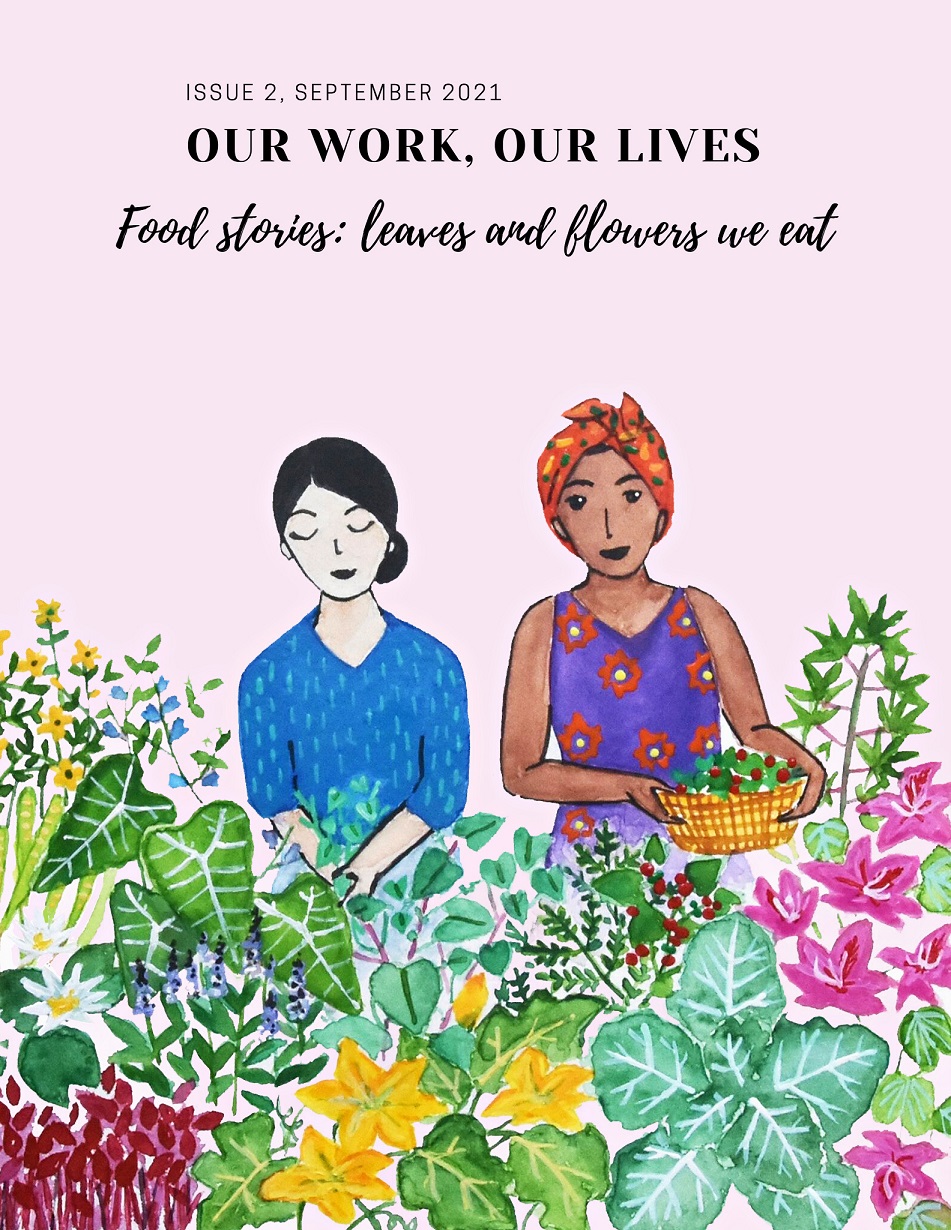
Our Work, Our Lives, issue 2: Food stories
- Details
- Category: Our Work, Our Lives
Dear Friends,
We are delighted to bring you the second issue of Our Work, Our Lives. The theme of this month is Food Stories: leaves and flowers we eat.
Food stories are political. Policies decide who gets to eat what, how much and who makes profit on the backs of food producers. Struggles for food security and sovereignty are also integrally linked with people’s struggles to realise their rights to land, water, forest, safe environment, livelihoods, and health.
Hunger is on the rise, with as many as 811 million people worldwide going to bed hungry every night. Even though small farmers, fishers, and indigenous people produce about 70 percent of the global food supply, they are the ones who experience food insecurity. Six out of ten people who are food insecure are women. In the words of Michael Fakhri, the UN Special Rapporteur on the Right to Food, “Hunger, malnutrition and famine are not caused by inadequate amounts of food. They are caused by the political failures that restrict people’s access to adequate food.”
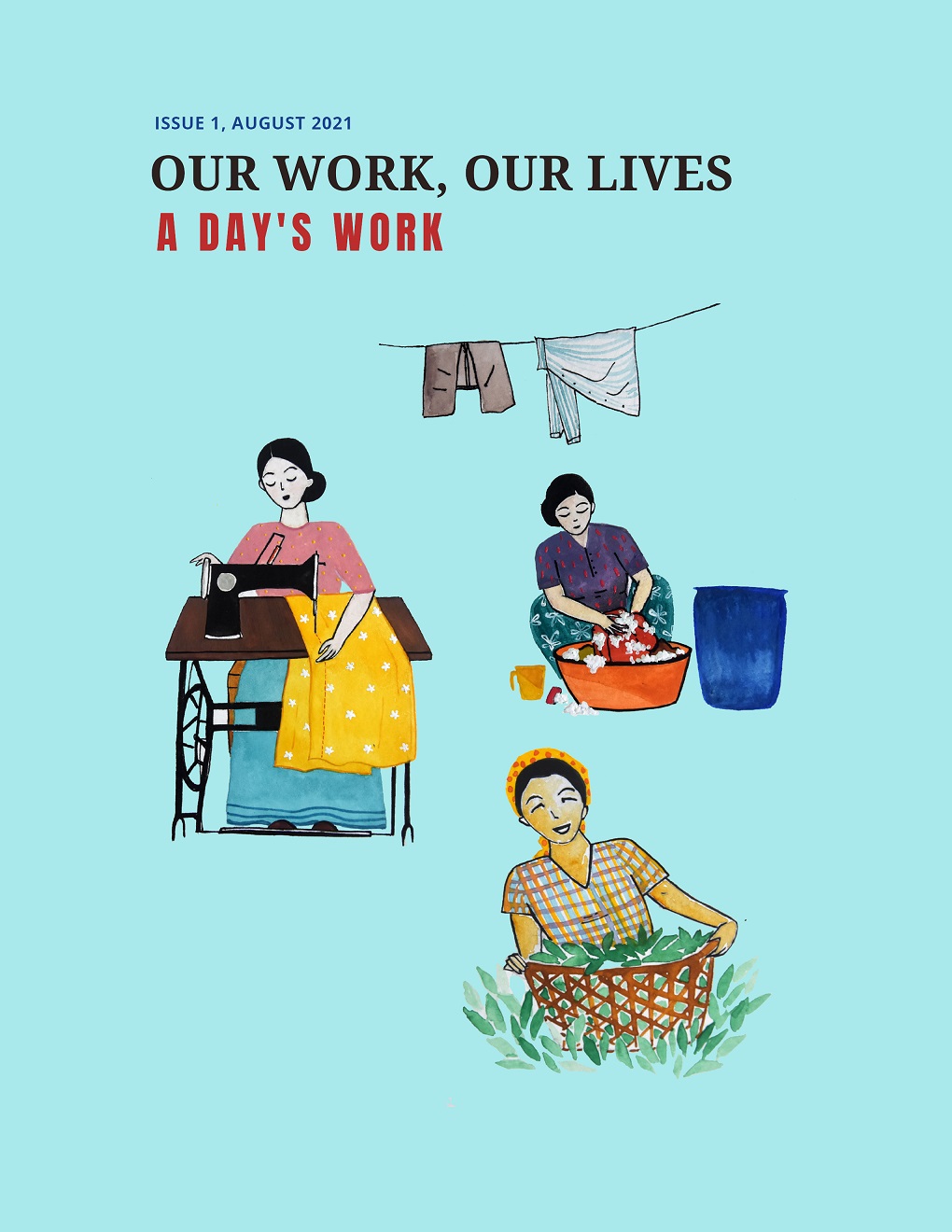
Our Work, Our Lives: GAATW’s New E-Magazine
- Details
- Category: Our Work, Our Lives
By Bandana Pattanaik
In mid-2020 when we were still sceptical and confused about online work, our colleagues in Indonesia made us feel hopeful. By holding a series of inter-movement dialogues online, they showed us how to push the limits of digital communication. As my colleague Cris and I participated in the strategic conversations via WhatsApp translation while watching the speakers via Zoom, we realised that ingenuity might be the only way forward. Our colleagues from Self Employed Women’s Association (SEWA) in India and JALA-PRT in Indonesia inspired us by developing political education handbooks for domestic workers at a time when they were also busy organising emergency support and alternative livelihood for the workers.
By early 2021, we were ready to start online conversations on women, work, and migration with our members and partners located in places with limited and unreliable internet connections. Many of these colleagues work closely with migrant and local women workers in low-wage jobs – the workers hit hardest by the ongoing pandemic. Our discussions led us to talk about women workers’ agendas for change. We also wanted to know if our colleagues facilitate workers’ organising and education.
This is how we began an experimental initiative called Women Workers for Change. It brought together twenty-five GAATW members and partners from Africa, Asia, and Latin America working with women who earn their living from domestic work, sex work, agriculture, weaving, entertainment work, garment sector work, home based work and any available daily wage work. Additionally, most of these women do all the care work for their families. These structured online discussions, which were held between April and July 2021, were an opportunity for mutual learning and strategy sharing. We now notice that those who had not focussed on workers’ organising before felt inspired to do so and want to develop their organising skills. Those who were already self-organised or worker-focussed have begun taking proactive steps towards deepening political education of workers.
GAATW E-bulletin: Issue 2, August 2021
- Details
- Category: E-Bulletin
Dear friends,
In many parts of the world, our sister organisa ons are ba ling a (re)surge of COVID- 19 infections. We lost friends and comrades from India in the past few months and we hope that our members and friends in Indonesia, where the situa on is par cularly bad, are staying safe. Countries in Europe and North America con nue to hoard vaccines, while many in Asia, Africa and La n America are struggling to secure anywhere near enough doses. Even when this eventually happens, misinforma on on social media, especially Facebook, will probably hamper vaccina on efforts – as is already happening in the Global North.
In other tech news, it was recently revealed that so ware developed by an Israeli company, and likely backed by the state, has been used for unauthorised surveillance of journalists, human rights defenders, and poli cal opposi on leaders. The assault of autocra c governments, corpora ons, and technology companies on democracy, human rights, and social cohesion is relentless.
Boletín en español, Mayo 2021
- Details
- Category: E-Bulletin
Queridas amigas y amigos,
Saludos desde Bangkok. A mediados de abril, el Secretariado hizo una pausa por Songkran, el Año Nuevo Tailandés. Mucha gente en el sudeste y sur de Asia celebra el Año Nuevo a mitad de abril. La palabra Songkran proviene del término sánscrito Sankranti que significa pasaje, un tiempo para el cambio. Muchas personas budistas e hinduistas señalan este período como su año nuevo, un nuevo comienzo. El Thingyan de Myanmar, Chol Chnam de Camboya, el festival del agua de Yunnan, Boun Pi Mai de Laos, Bisuba Sankranti de Odisha, Bohag Bihu de Assam, Pahela Baishakh de Bengal Oeste y Vishu de Kerala son diferentes nombres para esencialmente la misma idea. La gente señala el pasaje del sol del signo zodiacal de Piscis a Aries. También suelen usar agua simbólicamente para purificarse a sí mismas y a sus casas, bañan a Buddha, riegan la planta sagrada de albahaca, se arrojan agua perfumada unas a otras, visitan a familiares y amistades y generalmente disfrutan de este tiempo.
Tailandia celebra el Año Nuevo tres veces en un año; el 1ero de enero, durante el Año Nuevo Chino en febrero y de nuevo en el tiempo de Songkran en abril. Pero esta es la segunda vez consecutiva que las festividades se vieron afectadas por el miedo y la preocupación a causa de la pandemia de COVID-19. Todxs tenemos ahora algún conocimiento sobre la pandemia y las medidas preventivas necesarias. Sin embargo, las personas también están cansadas y frustradas, por lo que han relajado las medidas de cuidado y en ocasiones están siendo poco prudentes. En Tailandia no se están haciendo testeos proactivamente, y el proceso de vacunación ha sido lento. Están apareciendo focos de infección comunitaria periódicamente y nadie sabe cuándo terminará esta sombría situación.
GAATW E-bulletin: Issue 1, April 2021
- Details
- Category: E-Bulletin
Dear friends,
Greetings from Bangkok. I am writing this just before we take a week’s break for Songkran, the Thai New Year. Many people in Southeast and South Asia celebrate the New Year in mid-April. The word Songkran comes from the Sanskrit word Sankranti which means passage, a time for change. Buddhists and many Hindus mark this period as their new year, a new beginning. The Thingyan of Myanmar, Chol Chnam Thmay of Cambodia, Dai water festival of Yunnan, Boun Pi Mai of Laos, Bisuba Sankranti of Odisha, Bohag Bihu of Assam, Pahela Baishakh of West Bengal and Vishu of Kerala are different names for essentially the same idea. People mark the passage of the sun from the zodiac sign of Pisces to Aries. Many use water symbolically to cleanse themselves and their houses, bathe the Buddha, water the holy basil plant, splash scented water on each other, visit family and friends and generally have a joyful time.
Thailand celebrates New Year three times in a year; on 1 January, during the Chinese New Year in February and again at Songkran time in April. But this is the second time in a row that the festivities are going to be affected by fear and worry about the COVID-19 pandemic. Everyone has some knowledge about the pandemic and the necessary preventive measures now. However, people are also tired and frustrated so are letting go of caution and being careless.
Boletín en español, Enero 2021
- Details
- Category: E-Bulletin
Queridas amigas y amigos,
¡Saludos desde el Secretariado Internacional de GAATW!
El 2020 ha finalmente llegado a su fin y ¡qué año ha sido! Todas y todos hemos sentido confusión, miedo, estrés y preocupaciones como nunca antes. No ha sido posible llevar a cabo nuestro trabajo tal como había sido planificado y hemos tenido dificultades para adaptarlo a la situación cambiante. No solo ha sido difícil o imposible viajar internacionalmente, sino que nos ha tocado estar confinadas en nuestras casas por semanas e incluso meses. Nuestra comunicación con miembros de la familia, amigas, amigos y colegas en otros países se ha visto mediada por la tecnología. Trabajar desde casa o de manera remota desde otros países se ha vuelto una necesidad. Y en un esfuerzo por dar sentido a las cosas, aprender de otras y otros colegas y compartir nuestros pensamientos con ellas y ellos, hemos tratado de acomodar múltiples zonas horarias y organizar muchas sesiones online. Estas sesiones funcionaron hasta cierto punto, pero también nos dejaron con una extrema fatiga de Zoom al final del año.
En la otra cara del espectro del trabajo, millones de trabajadoras y trabajadores han perdido sus trabajos y no saben cuándo volverán a encontrar empleo. El apoyo por parte de los gobiernos ha sido altamente inadecuado, y con frecuencia excluyó a las y los trabajadores migrantes e informales.
GAATW E-bulletin: Issue 4, December 2020
- Details
- Category: E-Bulletin
Dear friends,
Greetings from the GAATW International Secretariat!
The year is coming to an end and what a year it has been! All of us have experienced confusion, fear , stress and worries as never before. It has not been possible to carry out our planned work and we have struggled to adapt it to the changed situation. Not only has international travel been difficult or impossible, we have also had to stay confined to our homes for many weeks or even months. Our communication with family members, friends and colleagues in other countries has been mediated by technology . Working from home or working remotely from another country has become a necessity . In our efforts to make sense of things, to learn from other colleagues and share our thoughts with them, we have tried to straddle multiple time zones and organised many on-line sessions. Those sessions worked to some extent but have also left us with tremendous zoom-fatigue at the end of the year.
At the other end of the work spectrum, millions of workers have lost their jobs and do not know if and when they will find employment again. Support from governments has been largely inadequate, and often excluded migrant and unregistered workers. Economies around the world have collapsed and recovery is going to take a long time. Although the vaccine offers some hope, it is going to take a long time before everyone feels safe again.
Boletín en español, Septiembre 2020
- Details
- Category: E-Bulletin
Queridas amigas y amigos,
En diversas partes del mundo, nuestras organizaciones hermanas están luchando contra una nueva ola de infecciones por COVID-19. Hemos perdido amigxs y compañerxs en India en los últimos meses, y esperamos que nuestrxs colegas en Indonesia, donde la situación es muy preocupante, estén a salvo. Los países de Europa y América del Norte continúan acumulando vacunas, mientras que muchos otros en Asia, África y América Latina están luchando por conseguir dosis suficientes. Incluso cuando esto finalmente suceda, la desinformación que circula en redes sociales, especialmente en Facebook, probablemente obstaculizará los esfuerzos de vacunación, como ya está sucediendo en el Norte Global.
En otras noticias de tecnología, se reveló recientemente que el software desarrollado por una empresa israelí, y probablemente respaldado por el estado, se ha utilizado para la vigilancia no autorizada de periodistas, personas defensoras de derechos humanos y líderes de la oposición política. El asalto de gobiernos autocráticos, corporaciones y empresas de tecnología a la democracia, los derechos humanos y la cohesión social es implacable.