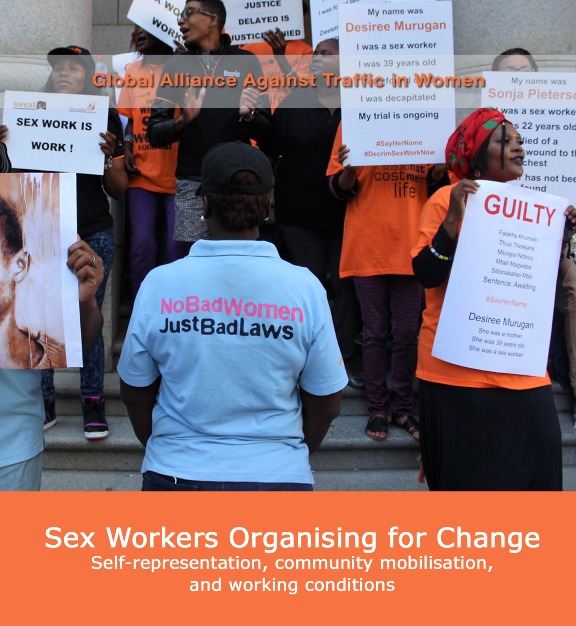
Sex Workers Organising for Change: Self-representation, community mobilisation, and working conditions
- Details
español polski svenska français italiano português руский deutsch
Sex worker rights organisations are creatively responding to violence, exploitation and other abuses within the sex industry, including instances of human trafficking, according to a new report published by the Global Alliance Against Traffic in Women, Sex Workers Organising for Change: Self-representation, community mobilisation and working conditions.
The report is based on research conducted with sex worker organisations in seven countries: Canada, Mexico, Spain, South Africa, India, Thailand and New Zealand. It highlights cases where sex workers, or sex worker organisations, learnt of situations where a woman was experiencing violence, working under unacceptable conditions, or was brought to the industry through force or deception, for the purpose of exploitation. In these instances, sex workers resolved the issue as a collective, by providing advice and referral to other organisations, negotiating with the brothel owner/madam, chasing the pimp out of their area, or gathering money to help the woman return home.
Beyond support for individual cases, this report also documents how sex worker rights organisations mobilise sex workers and their allies to resist stigma, discrimination and oppression, and to collectively voice their concerns, demand their rights, and participate in public and political life. This type of collective action builds confidence in sex workers and helps them better protect themselves and their peers against violence and abuse.
II Critical Assessment of the Implementation of Anti–Trafficking Policy in Bolivia, Colombia and Guatemala
- Details
For the second year in a row, Fundación La Paz, Corporación Espacios de Mujer and ECPAT, with the support of the International Secretariat of GAATW, conducted an analysis of anti-trafficking policies and services in Bolivia, Colombia and Guatemala to assess the gap between what the legislation states and the services actually provided.
The reports find that the legislation against human trafficking is still not effectively implemented in any of the three countries. Institutions are not fulfilling all of their responsibilities nor are they facilitating the restitution of the violated rights of trafficked persons. Not only is there an inadequate budget allocation to enforce the law, but most institutions responsible for prevention, care or prosecution are unaware of the budget available for their implementation. There is no uniformity in the collection of information, which results in a high degree of ambiguity and, therefore, a lack of knowledge about the crime and associated violations. A proper recording of trafficking cases would make it possible to classify and quantify information for the purpose of designing more appropriate public policies.
One need identified in all three countries is ongoing training of specialists involved in the processes of identification, care, protection and prosecution. Finally, it is worrisome that states generally continue to fail to link prevention strategies with public policies that deal with structural aspects, such as poverty or the guarantee of basic rights.
Enabling Access to Justice: A CSO Perspective on the Challenges of Realising the Rights of South Asian Migrants in the Middle East
- Details
In 2015-2016, the GAATW International Secretariat implemented a project to identify cases in which migrant workers from South Asia who had travelled to the Middle East as temporary labour migrants were trafficked, and to identify the barriers those workers faced accessing justice. A total of thirteen partner organisations from seven countries (Bangladesh, India, Jordan, Lebanon, Kuwait, Nepal and Sri Lanka) participated in the project.
This report captures one area of learning that emerged from the project: the barriers that project partners experience or observe when supporting migrant workers to access justice. It concludes with reflections on the lessons learnt by GAATW about the obstacles to justice for migrant workers, but also for organisations seeking to assist migrant workers and the effort to overcome those barriers. It highlights the complexity of human trafficking, and the many challenges along the road to justice.
Access Unknown: Access to Justice from the Perspectives of Cambodian Migrant Workers in Thailand
- Details
Cambodian migrant workers in Thailand usually do not pursue justice after rights violations due to a lack of trust in the police and courts, research conducted by GAATW and partners found.
Lack of information about labour and migration laws and regulations was one factor among those interviewed that made them vulnerable to exploitation and human trafficking. When violations occurred they did not seek justice, either because they are undocumented or because they don’t believe they will receive a fair outcome against a Thai employer. Interviewees spoke of lack of examples of success that might inspire their pursuit of justice - no one they knew had successfully accessed a fair resolution though the legal system.
These are some of the main findings of our new research ‘Access Unknown: Access to justice from the perspectives of Cambodian migrant workers in Thailand’, which interviewed 59 migrant workers, men and women working in seven different industries, in Thailand and after returning home. This research aimed to examine why there is still such a significant disconnect between the currently available options in the legal system and Cambodian workers’ unwillingness or inability to practically access them.
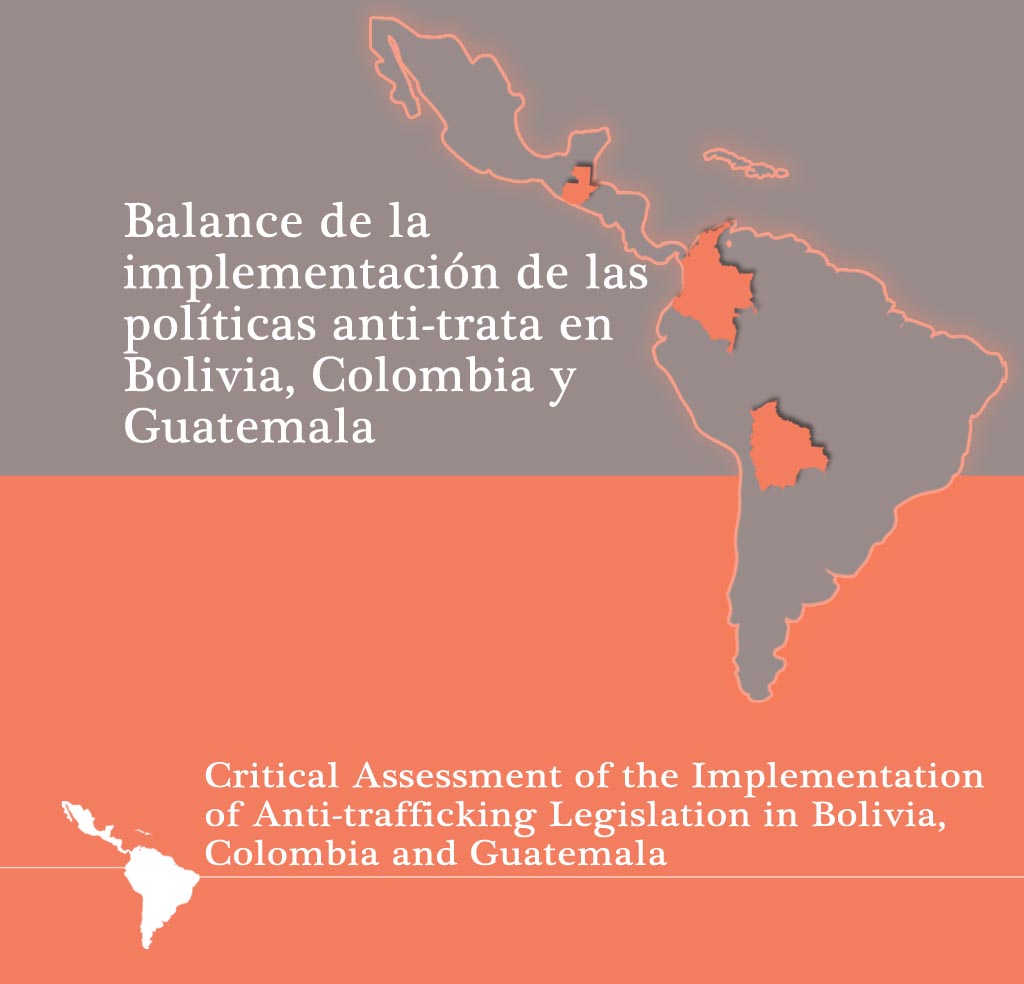
Critical Assessment of the Implementation of Anti-Trafficking Legislation in Bolivia, Colombia and Guatemala
- Details
The Global Alliance Against Traffic in Women (GAATW) carried out this joint evaluation in three countries in Latin America – Bolivia, Guatemala and Colombia - with the aim of encouraging governments to improve the implementation of anti-trafficking laws and policies to better respond to the needs of trafficked persons. The report highlights (1) the existing gaps between what the anti-trafficking legislation states and the actual services provided by government agencies, and (2) concrete recommendations for the three governments to take forward.
This project was developed by Fundación La Paz in Bolivia, Corporación Espacios de Mujer in Colombia and ECPAT in Guatemala with the support from the GAATW International Secretariat and the Peruvian NGO Capital Humano y Social (CHS) Alternativo.
Briefing Papers: “Towards Greater accountability - Participatory Monitoring of Anti-Trafficking Initiatives”
- Details
The Global Alliance Against Traffic in Women (GAATW) believes that the impact of anti-trafficking initiatives is best understood from the perspective of trafficked persons themselves. In 2013, 17 GAATW member organisations across Latin America, Europe, and Asia undertook a participatory research project to look at their own assistance work from the perspective of trafficked persons. GAATW members interviewed 121 women, men and girls who lived through trafficking to find out about their experience of assistance interventions and their recovery process after trafficking. The project aimed to make the assistance programmes more responsive to the needs of the clients and to initiate a process of accountability on the part of all anti-trafficking organisations and institutions.
These briefing papers highlight the main findings of what people who have been trafficked say about 3 important themes:
- Unmet Needs: Emotional support and care after trafficking [English, Spanish]
- Rebuilding Lives: The need for sustainable livelihoods after trafficking [English, Spanish]
- Seeking Feedback from Trafficked Persons on Assistance Services: Principles and ethics [English, Spanish]
With translation support from Translators without Borders.
Regional Report: “Towards Greater Accountability - Participatory Monitoring of Anti-Trafficking Initiatives”
- Details
The project of the Global Alliance Against Traffic in Women (GAATW), "Towards greater accountability - Participatory Monitoring of Anti-Trafficking Initiatives”, aims to reaffirm the right of surviving victims to express their voices, by monitoring initiatives that are intended to benefit them.
The research study aimed to identify victims’ perceptions and views of the support services they received, which would be reflected in the respective country reports. The participant organisations in the research had provided some form of assistance to surviving victims that had participated in the study. Seven of the organisations that participated in the research are from Latin America and the Caribbean: The Civil Human Rights Association of United Women Migrants and Refugees in Argentina (AMUMRA) of Argentina; Renacer, Hope Foundation and Space Corporation Foundation Women of Colombia; Ecuador Hope Foundation; Street Brigade Support Women "Elisa Martinez", AC of Mexico and Alternative Forms of Human and Social Capital (CHS Alternativo) of Peru.
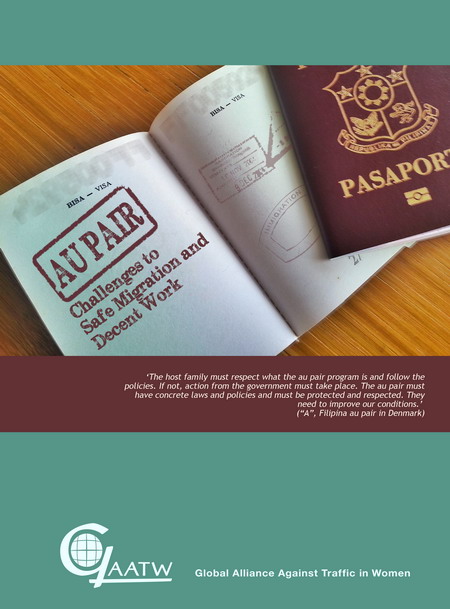
AU PAIR: Challenges to safe migration and decent work
- Details
In GAATW’s 2010 Working Paper Series Beyond Borders, links between trafficking and migration, labour, gender and security are explored and developed conceptually. This working paper seeks to build on the earlier work by developing a practical understanding of safe migration, with specific reference to a case study on au pair migration.
The scope for this research focus on Filipina au pairs in three European countries: Denmark, Norway and the Netherlands, which are the top receivers of au pair migrants from the Philippines. This working paper provides an overview of the existing policies on au pair migration in these three countries and also includes a case study of the situations and experiences of Filipina au pairs in one country of destination: Denmark.
This paper includes three separate sections of analysis which are summed up in a chapter on recommendations at the end. The first section gives an introduction to safe migration, in particular, to its challenges, and considers how concepts related to safe migration can be linked to au pair migration. The second section presents existing policies and regulations of the country of origin (the Philippines) and the destination countries (Denmark, Norway and the Netherlands). The third section presents the findings of a case study of Filipina au pairs in Denmark. The final section of the report seeks to address the challenges identified in the analysis by setting out a range of recommendations to be considered by policy makers.