In June, Vivian Cartagena, Programme Officer for Alliance Strengthening at GAATW, interviewed Sumaiya from BNSK (Bangladesh Nari Sramik Kendra), to explore the organisation's history, its grassroots foundations, and its work supporting women migrant workers across Bangladesh and beyond. Sumaiya shared how BNSK grew from a community-based organisation into a movement connecting women workers in the informal sector and overseas migrant workers, while centring lived experience, Dance and Movement Therapy (DMT), and ground-up advocacy in the face of multilayered challenges.
Vivian: Welcome Sumaiya, it’s really lovely to see you here and thanks for joining our conversation today. We would like to know how and why BNSK was founded. Could you tell me a bit of the context in which the organisation was thought to start, and what were the main goals?
S: Thank you for reaching out to us, it is a pleasure to share the story of BNSK. At the beginning, we saw that migrant workers were facing many problems, in-country and overseas, they were dealing with discrimination, dignity, and the non-protection of their rights. We saw this is a very early stage, and so we saw the need for organising and movement building.
Originally it was a community-based organisation, but over time we began to connect with more and more migrant workers who wanted to join us and raise their own voices. What we saw on the ground was very clear to us: workers needed deeper support, and policies needed to change. That kind of change can't happen through a single short-term programme.
So we realised we needed something more permanent and that’s when we thought of starting an organisation that brings together community groups, activists, lawyers, university teachers, each contributing their own expertise. That is our core purpose, to create a space that belongs to women migrant workers.
Vivian: Where were these migrant workers from? Are you referring to Bangladeshi workers abroad or any migrants in Bangladesh? Who was this organisation initially thought for?
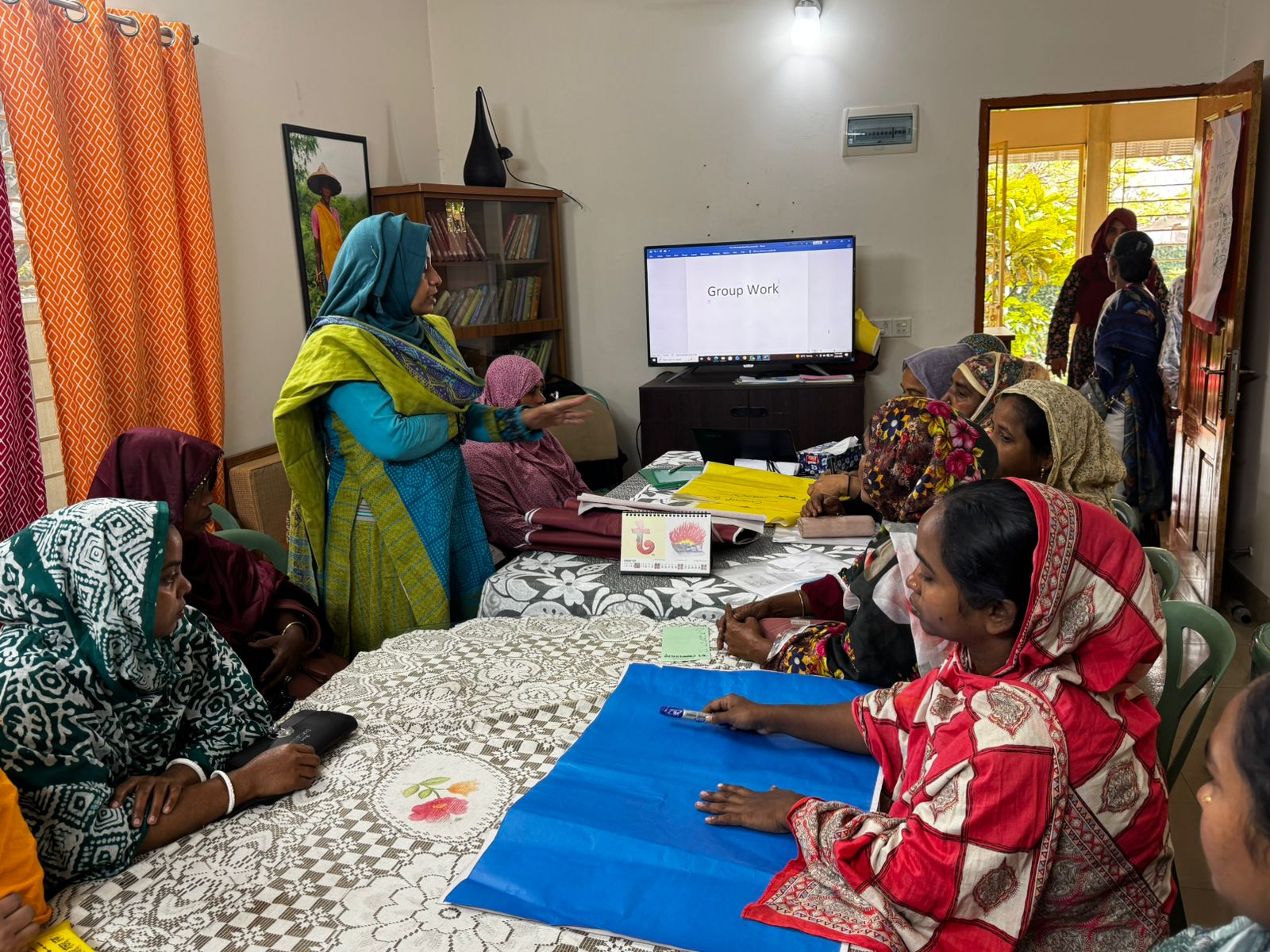
S: This organisation was aimed for both, in-country migrant workers and overseas migrant workers. Our main focus is on informal sector workers such as sex workers, street vendors, domestic workers, etc. At the same time, we are very much focused on overseas migrant workers who are going abroad as domestic workers and garment workers.
Vivian: That’s amazing! Can you tell us a bit more about the current programs and the focus that the organisation has? Do you have any training programs or public advocacy initiatives?
S: After we became a CBO, GAATW was our first development partner. Together with OKUP from Bangladesh, we carried out our first action research. Although policy advocacy has always been at the heart of what we do, action research is equally part of our agenda. Right now, we are working on two fronts, with in-country migrant workers on climate issues, and with overseas migrant workers on reintegration.
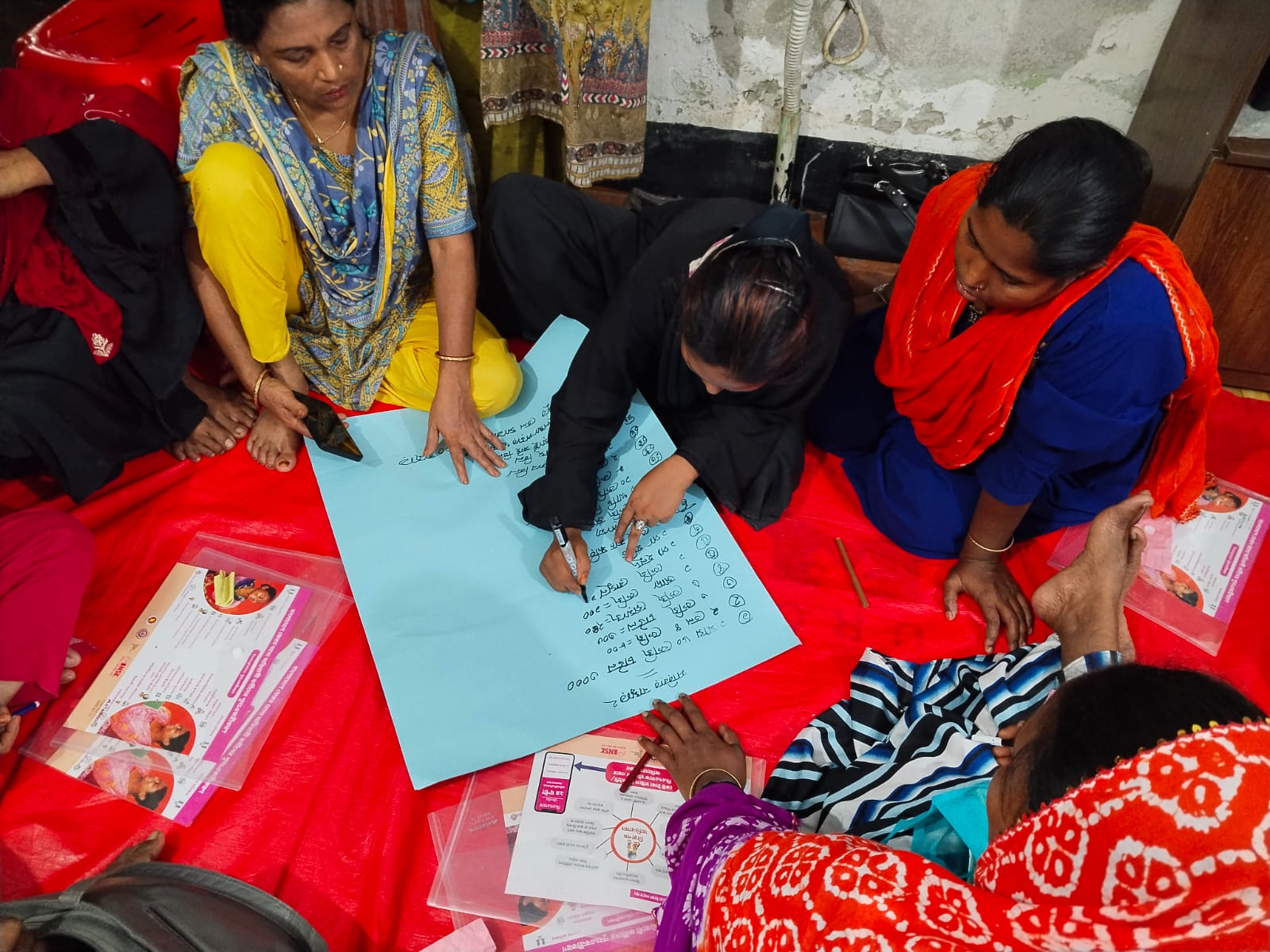
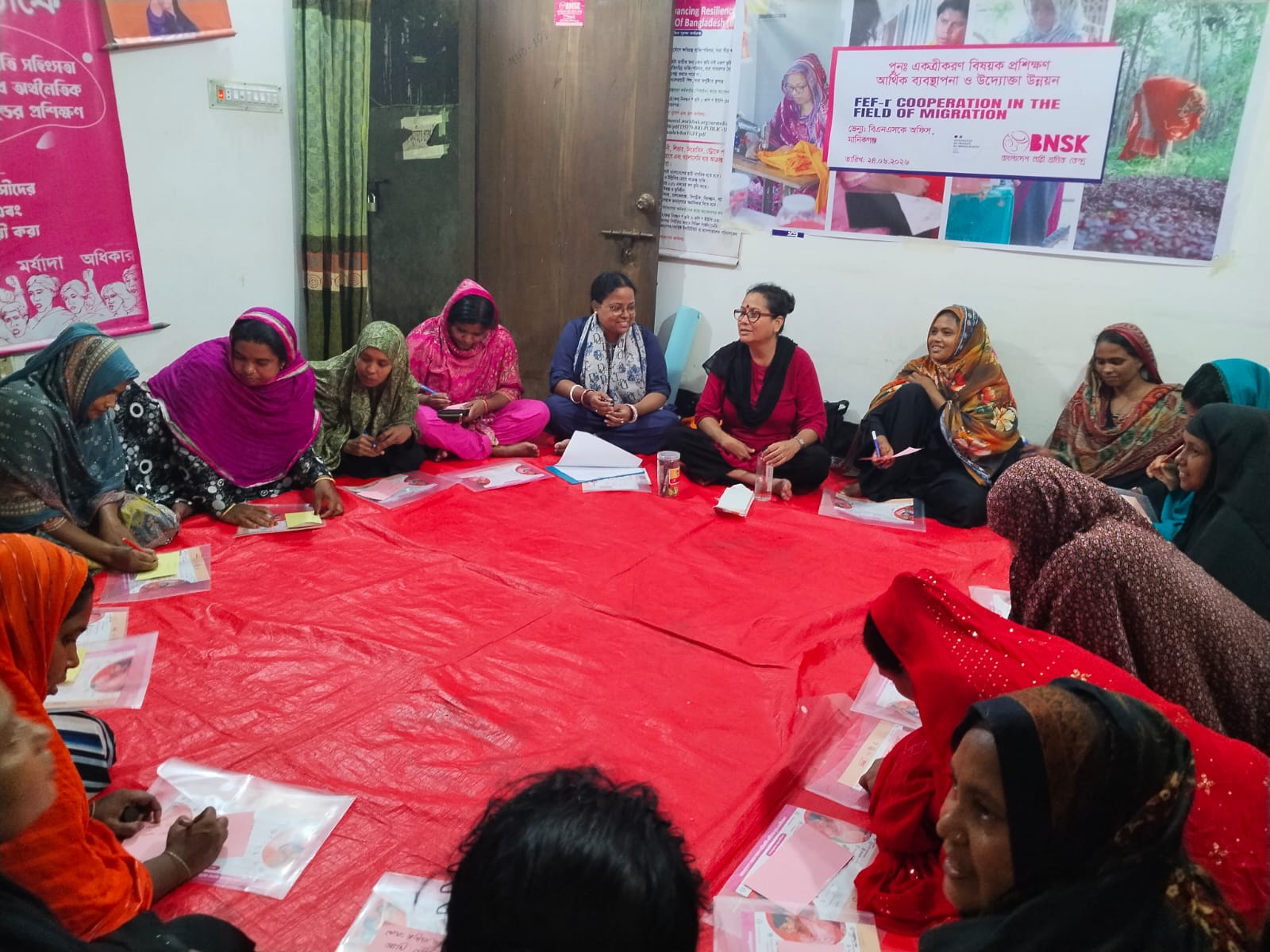
In terms of training, we are reaching more than 1,000 workers every month across 21 districts in our project area in Bangladesh. We try to reach as many workers as possible, covering the full journey from pre-decision and pre-departure all the way through to reintegration. We also have a dedicated module on economic leadership training. And through our partnership with GAATW, we adopted dance therapy which we now offer alongside yoga to our workers. Actually, both have been formally approved by the Government of Bangladesh. We are the only organisation to have received approval from the Bureau of Manpower, Employment and Training (BMET) to provide women migrant workers with dance therapy, yoga, and human rights training.
Vivian: Yes, that’s interesting, the Dance and Movement Therapy (DMT) has been very much appreciated among women migrant workers organisations because it’s not only about sharing the struggles around labour or migrants’ rights, it’s also about mental health priorities. It's interactive and creates a safe space for workers to process and share what they're carrying.
S: Absolutely! If you ever get the chance to visit, it will surprise you. These are women living in really poor conditions, many of whom never had the opportunity to go to school. Some can only sign their names, and fewer than 1% can read. So when these women discover that they have leaders standing with them - that when they are in a dark place, or when they face harassment, they can reach out to us, to the government, to other organisations - something shifts for them. At the same time, they realise that they have the right to leave, to enjoy their lives first, that they should recognise their worth and their power.
This is a very challenging job in Bangladesh, especially now as fundamentalist groups are growing day by day. We are facing real challenges. But when our workers dance with us, when they sing, when they dance, and when they cry, we really feel an enormous sense of joy and empowerment.
Vivian: Yes, exactly, this form of therapy surfaces so many feelings and emotions, but also invaluable insight into the burdens that women are carrying. I'd love to hear more about how DMT came into your organisation's work. Where did the inspiration to implement this come from, and what did you find when you first brought it to the field?
S: It came through our meetings with member organisations and participation in other GAATW meetings. I had the opportunity to learn, particularly from Bandana, about the work GAATW does for women workers. It is tremendous, and many networks don't even have a sense of the scale of what GAATW is doing globally and with its members. I also had the privilege of working with Dr. Irene Fernandez from Tenaganita, another memorable leader from whom I learned a great deal. What I took from both, I brought back and incorporated at the grassroots level.
When we took it to the field, the response was very positive, but we also discovered something important. That these women are often reluctant to speak up or share their experiences, their emotions. Many believe that training and programmes like these are only for educated or wealthy people and not for them, so we found that approaching them through health issues and other entry points helped us get closer, and that is what opened the door to reaching them.
Vivian: Yes, and that's exactly where I was heading to. Once you build that trust and women start opening up, not just about personal matters but about the day-to-day challenges they face around work and migration, how do you capture what they share and feed it back into your programmes and advocacy? Is it a bottom-up process, where lived experience drives the agenda, or does it tend to be more of a top-down process?
S: Just to be clear, this was not a top-down decision, it was the opposite. When we go to the grassroots level, through pre-decision sessions and community meetings, we find out directly what workers actually need and how best to reach them. That is what shapes the approach in our work.
And when it comes to policy advocacy, the challenge is huge. Most of the time, our government is looking to restrict the sending of workers abroad, for example, there are already bans in place in Nepal and in Bangladesh. We do a great deal of advocacy on this front, so we are constantly working out how to keep reaching workers, while at the same time bringing our policy and research findings to the government and building enough of a pressure group to push for rights-based approaches. It has not happened yet so the system remains deeply exploitative. But yes, this is a ground-to-top process, not top-down.
Vivian: Thank you for that explanation. You’ve mentioned that some of what you are working toward, in terms of dialogue with local governments and public policy change, has not been achieved yet. So I'd like to know more about the biggest challenges in the current context of Bangladesh. There have been significant protests in recent years, and many well-documented cases of exploitation by companies. Have you also encountered cases of trafficking? What does the landscape look like right now, and what are the biggest challenges your organisation is facing?
S: There are multiple obstacles that we are facing at this moment. Funding is a serious one, resources are being squeezed now, and at the same time, civic space is shrinking. Day by day, the conditions are becoming harder, and what worries me most is that people and movements are growing more fragmented rather than coming together to speak with a unified voice. On a personal level, I also feel that advocacy has become increasingly organisational, meaning it is institution-driven now, while before it was more collective, more movement-based.
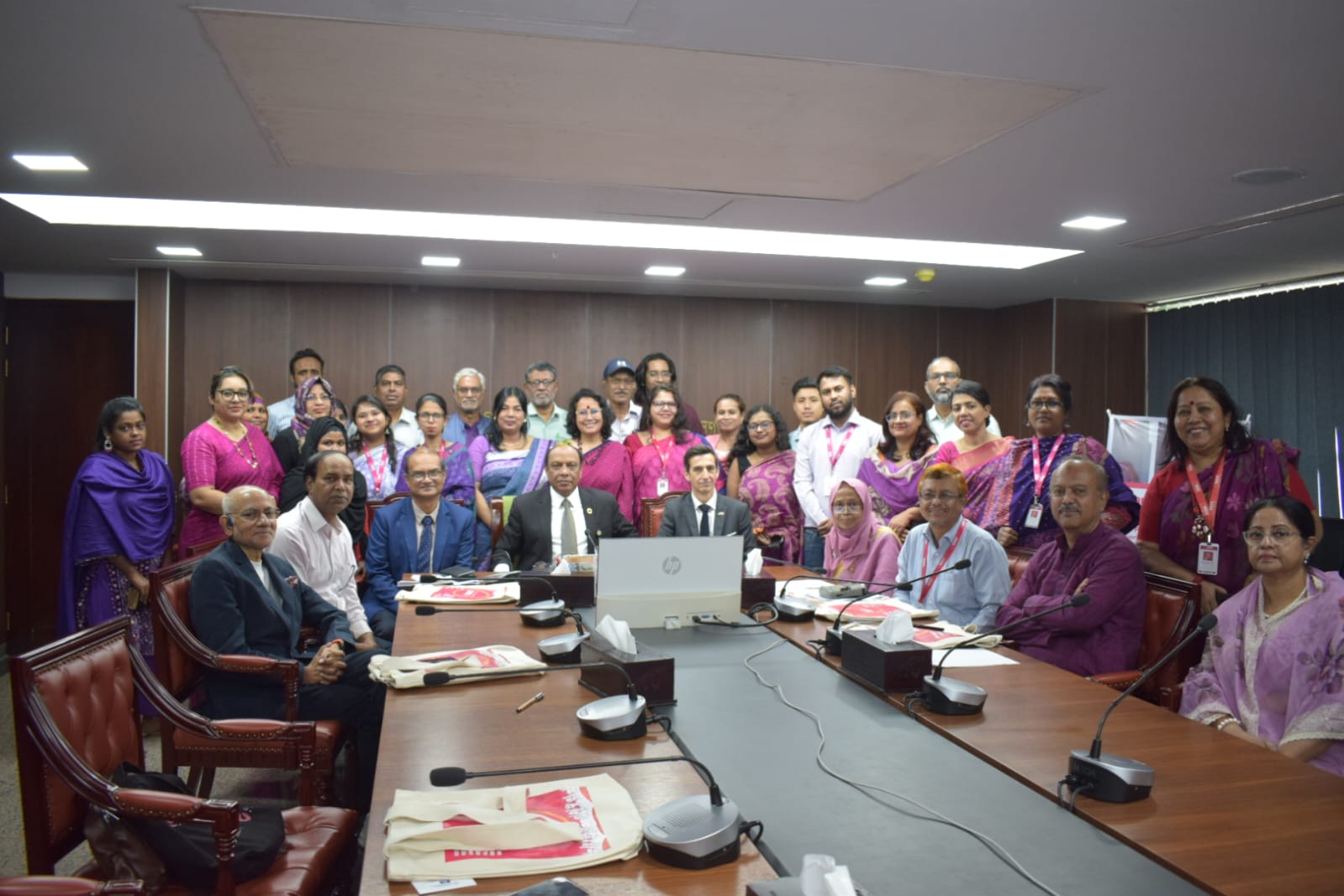
From the government’s side and the recruitment agencies’ side, there is a persistent hostility because now NGOs are seen as the enemy. When we file any trafficking or migration case, what often happens is that the recruiting agency and the migrant worker come to an agreement behind the scenes so money changes hands, and the case is withdrawn. That is the kind of challenge that we are facing right now.
Then there is also the issue of access to justice, which is entirely centralised. Our workers come from the most remote grassroots levels, but they cannot participate in hearings and legal processes that require them to be physically present. We have been pushing the government to move these processes online because these are very poor women who cannot afford to travel to Dhaka repeatedly, let alone stay here for one night or two. Decentralisation remains a critical unresolved issue for us and the access to justice. And on top of all of this, the cost of migration itself remains far too high.
And this is also our failure after 25 years of working on these issues. We are still confronting what is essentially a bonded labour system. That is one of the deepest sources of frustration for us because workers cannot move freely, or enjoy the fruits of their own labour. Women are out there working, but the money flows directly to their husbands, their fathers, their brothers. They don’t have control over what they earn! At the end of the day, you have a woman who has worked two, three, four times harder than anyone around her, and for ten or twelve years and her say over financial decisions is zero. She has built everything and owns nothing, so financial autonomy remains a profound crisis. And as you can see, there are so many crises!
Vivian: Yes, and actually, we have seen the same challenges reflected in Nepal as well. At their core, these are cultural issues, deeply related to norms that are incredibly difficult to shift overnight. On the topic of your membership at GAATW, you are one of the most longstanding members, with an admirable experience and a history that goes back to the very beginning. And more recently, last year, BNSK joined the Labour Rights Group. I'd like to hear from you what BNSK's expectations and goals are within this thematic group?
S: As a lawyer, what I see clearly is that in countries of destination, the legal rights of overseas migrant workers are extremely low. For example, in Saudi Arabia, Jordan, Dubai, Qatar, and anywhere across the Gulf countries, domestic workers, and even sex workers, are not enjoying their rights. And when I say rights, I mean health rights, legal rights, access to justice. All of it is essentially zero. Ten years ago, the salary was 1,000 riyals. Today, it is still 1,000 riyals. On top of that, almost 90 to 95% of workers report that they are not receiving their full salary, because their employers are withholding three, four, sometimes six months of wages, and there is no mechanism to monitor this or ensure that workers are actually being paid.
The rights violations are a big problem as there is no comprehensive mechanism, neither in the origin country nor in the destination country, to address them. What we need to do as a labour rights group within GAATW is to systematically document these cases. I think that even ten to fifteen case interviews would give us something concrete to bring before national governments and international bodies so they understand that ground-level civil society organisations and global networks are watching, are organised, and are prepared to bring these issues directly to their attention. We have to hold on to the hope that visibility can lead to change.
I know that Bandana and the team have done very strong work, and I have genuine confidence in this group and in the activists I know from India and Bangladesh. They continue to be powerful voices on the ground. I myself served as a member of the Women Reform Commission under the last government, and we published our Women Reform Report. I will send you the English version and I hope you will find it worthwhile.
However, what followed the launch of the report was deeply troubling. After the report was released, fundamentalist groups in Bangladesh took to the streets demanding the death penalty for nine of our members. It was around the 3rd of May last year. It was a large demonstration, and they put up our photos with labels calling us prostitutes, framing it as though we were proudly claiming that identity while demanding land rights, sex workers' rights, and other reforms.
So, as a GAATW member, I want to say clearly that there is a significant need for all members to come together, whether through online case support, documentation, or direct advocacy, and take these cases to national governments and global bodies so they are forced to acknowledge and act on what is happening on the ground. I recently came across footage showing workers who had valid Kafala permission to remain in Saudi Arabia for nine months, and then Saudi police removed them, put them in jail, and released them with nothing. Their passports had been confiscated, even though they had every legal right to be there. This is a clear and serious violation of human rights, and it must be brought before both the destination and origin country governments. They have a responsibility to protect their workers abroad, and they must be held accountable to it.
Vivian: That's really powerful, Sumaiya! Have you had a chance to share that with our members? I'd definitely encourage you to do so, because it could be a powerful way to bring members together and keep the collective advocacy going.
S: This year, we are planning to organise events for Domestic Workers Day and Anti-Trafficking Day. We are also a member of the National Government Committee on Anti-Trafficking under the Ministry of Home Affairs, so we have a number of programmes running through that, alongside our ongoing work with domestic workers. And of course, there is always the day-to-day work that keeps everything moving. Our team is strong and deeply committed, although we are currently rebuilding our website, which has not been functioning as it should. That is very much a work in progress.
Vivian: So for July you also have anti-trafficking activities with the government?
S- Yes, we are working with some members of the Committee on anti-trafficking activities. However, there is something we need to be very attentive about: trafficking is increasingly being conflated with migration. Under the banner of anti-trafficking, safe migration pathways are being threatened and this is coming not only from our own government but from some American organisations as well. That is deeply problematic and we cannot allow that to happen. So we have to look at this issue carefully, analyse the situation on the ground rigorously, and keep pushing forward in order to avoid the criminalisation of migration.
Vivian: I think the last point is a really important and on-going issue. The conflation of anti-trafficking with migration control is something we all need to watch very carefully, and it’s good news that BNSK is doing exactly that. Thank you for your time, Sumaiya, it has been a real pleasure having this conversation with you today.